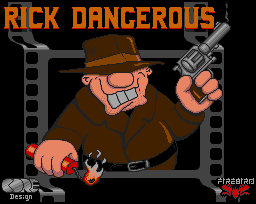
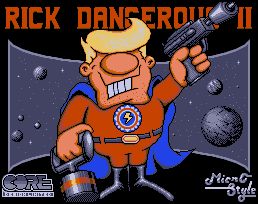
Remember Rick Dangerous?
Way before Lara Croft, back in the 1980's and early 1990's, Rick Dangerous was the Indiana Jones of computer games, running away from rolling rocks, avoiding traps, from South America to a futuristic missile base via Egypt and the Schwarzendumpf castle.
And then came Rick Dangerous II, taking our hero to the Ice Caverns of Freezia, the Forests of Vegetablia, the Atomic Mud Mines, and utimately to the Fat Guy Headquarters. Later on came Rick Dangerous II½, a short promotional yet somewhat incomplete version.
The games were originally and officially released on a few platforms: Atari, Amiga, IBM PC, Amstrad... each with their own unique particularities. The IBM PC CGA graphics and poor sounds were certainly no match against the Amiga :)
Rick Never Dies
In the game, Rick dies a lot. It was in fact one of the criticisms of the game: it is hard and requires memorizing tons of traps and movements, with any single mistakes meaning death and starting all over again. But in Internet life, Rick has remained surprisingly alive along the years. Simon Phipps, original designer and programmer, has pages about Rick Dangerous and Rick Dangerous II. Some websites such as Rick Dangerous Resurrected (english) or Rick Dangerous Forever (french) have collected almost-encyclopedic knowledge about the game.
Also, a quick Google search will take you to a wide amount of clones, rip-offs, ports, of varying quality and fidelity to the originals. But precisely: how can one play the original games on today's computers? This question, along with a passion for reverse-engineering, was at the origin of the xrick project.
xrick is an exact clone of Rick Dangerous, produced by carefully cracking and then reverse-engineering the orignal IBM PC (x86 CPU) and Atari ST (68k CPU) versions of the game, and then porting to C. This mostly manual task was started around 1992 and completed 10 years later in 2002. Thanks to its open structure, and the use of the SDL library, it has been reported to run on Linux, Windows, Mac, BeOs, Amiga, QNX, etc. and all sorts of gaming consoles, phones and devices.
Many were quick to ask for Rick Dangerous II. But reverse-engineering, even with more modern tools such as IDA Pro, remained a highly time-consuming exercise, not entirely compatible with a professional and family life. In this context, it is worth mentioning the efforts of Pierre-Marie Baty who spent the time that I was lacking figuring out some of the issues and polishing it all.
Enters AI: love it or hate it, given proper prompts and guidelines, and coupled with Ghidra or Hatari via MCPs, it has been able to completely review the original Rick Dangerous reverse, fix a wide range of issues with the port, upgrade to SDL3, run a complete Rick Dangerous II reverse, and port that one too. And thus in 2026, xrick got even better and became capable of playing both versions of the game! Event the infamous submap 18 mystery has been solved.
Let me Play!
The typical way to play is to get the source, build, play. As in, compile binaries. Irks. Alternatively, you can try and search the vast Internet for pre-built packages for your platform, if you have time. We do not distribute anything. Our build process is mysterious in many ways.
But there is a better way. It has been possible to play Rick Dangerous in the browser for years, thanks to Rick Dangerous Flash but, as the name implies, that requires Flash. And since it was created from an old xrick version, it only plays version 1. On the other hand, WebAssembly is now mainstream, and emscripten supports SDL out of the box. Which means... you can now play xrick in the browser!
Tell Me More
There is a docs page with details about command-line options, controls, etc.
xrick is published under the MIT License. At least, all the code. As for the artwork, and the gameplay itself, the situation is murky. I have discussed it with Simon Phipps in the past, and his Rick Dangerous page now has a paragraph about "who owns the rights to Rick now" and the answer is... it is hard to tell.
xrick relies on the AtariAudio library (MIT License) by the excellent Arnaud Carré for rendering original Atari sounds. And on the amazing SDL library (ZLIB Licence) for everything having to do with hardware (controls, audio, screen...).
There is no way to save and restore the game. That is the whole point of the game.
Despite what many people think, I have never made a single $ out of this.
On GitHub your can find the complete source code as well as the entire knowledge base. The latter linking the former as a submodule. It is super useful for debugging and understanding the game mechanics.
And then of course there's version II½ waiting to be reversed.
Rick's certainly not about to die.
I hope you have fun!
Stephan
The best way to contact me about this project would be to open an issue on the GitHub project, or via zpqrtbnk.net and Mastodon, @zpqrtbnk.